AI-Enhanced Facility Layout Optimization (VDB)
UT Creative Technology BSc graduation project for Van den Bos CM, a Dutch corrugated cardboard transport system manufacturer. A hybrid NSGA-II genetic algorithm with a two tier evaluator (millisecond surrogate plus SimPy DES) optimises factory layouts on conveyor length and routing efficiency, automating a workflow that currently takes weeks of manual back and forth.
Highlights
- Process level gene encoding collapses the search space from about 10 to the 90 down to about 5 to the 12 by encoding high level design decisions (machine_order, wip_type, corridor_slice, turntable_policy, speed_tier) in a 12 integer chromosome
- Two tier evaluation pipeline. The surrogate evaluator runs all 40 candidates per generation in milliseconds and only the top 20 percent (8 individuals) go into a full SimPy DES run. Total budget 160 SimPy runs over 20 generations instead of 800
- Layout B (Balanced) vs VDB baseline. 20.6 percent less conveyor length (645,000 mm vs 812,000 mm), 21 percent lower path ratio (2.38 vs 3.01), 15 percent higher throughput (117 vs 102 stacks per hour), 12.6 pp higher machine utilisation
- 100 percent layout feasibility by generation 5. Earlier prototypes had about 99 percent infeasibility because random (x, y) placement broke component connectivity
- A* path finding with octile heuristic on a 5 m grid, calibrated to the smallest factory obstacle (3 m radius pillar with 0.5 m safety margin)
- NSGA-II via pymoo 0.6.1 (pop=40, gen=20, uniform crossover 50 percent, bit flip mutation 8 percent, seed=42), early stop if HV improvement is below 10 percent across 5 generations. Final Pareto front of 38 feasible solutions on orders_mix120.xlsx
- Validation suite. 77 unit plus 12 smoke plus 5 regression plus 4 perf tests via pytest and pytest-benchmark, 71 passing, builder and validator and evaluator above 90 percent coverage
- Honest scoping in the thesis. Explicitly framed as proof of concept rather than a deployable industrial product, and the 'golden layout' baseline was itself a simplified VDB test layout not a real production floor
- CRISP-DM kept the work iterating between business understanding, data understanding, modelling and evaluation. The project pivoted twice (random placement to smart builder, DEAP to pymoo) and CRISP-DM made those pivots tractable
Deep dive
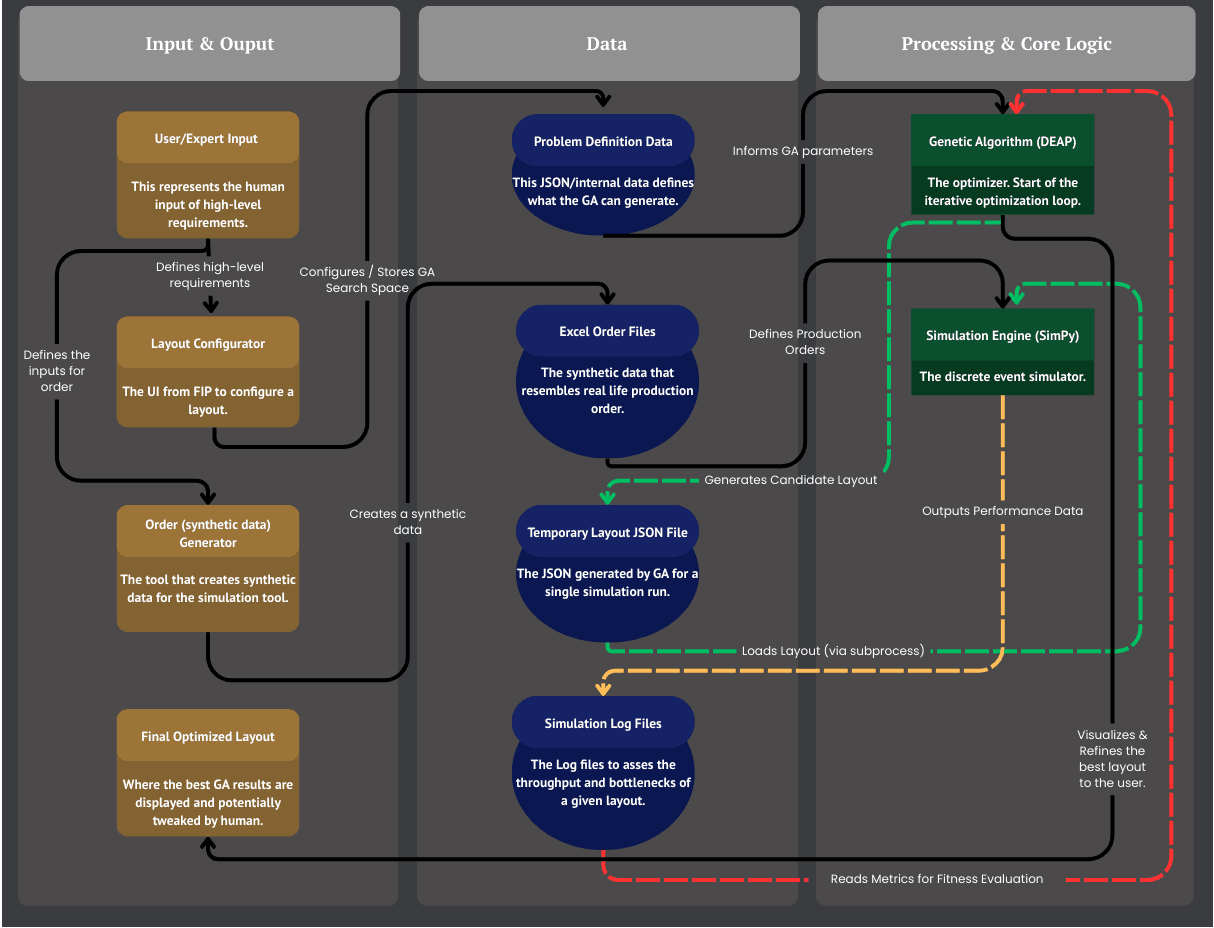
Van den Bos CM and Van den Bos Robotics design transport systems and software for the corrugated cardboard industry. Their current layout planning workflow is manual. A sales engineer drafts a configuration in CAD, iterates with the customer, and the cycle takes weeks to a month for a first plan, with no guarantee it is anywhere near optimal on energy, throughput or cost. This was the industrial problem for my 4th year Creative Technology BSc capstone at the University of Twente, supervised by Dr. F.A. Bukhsh with MSc. N. Bouali as critical observer, done with the Fraunhofer Innovation Platform for Advanced Manufacturing at UT (FIP-AM@UT) and company supervisor Can Olmezoglu. The methodology follows CRISP-DM and the KPIs are total conveyor length, path ratio (actual over Manhattan), machine utilisation, throughput (stacks per hour), feasibility rate per generation and hypervolume of the Pareto front. The system has four connected components. A PyQt5 Layout Configurator for manual authoring. An Order Generator producing synthetic production order Excel files. A SimPy 4.1.0 Discrete Event Simulator modelling the corrugator, conveyor, WIP buffer, transfer car and processing machine flow with PLC derived component logic. And a Genetic Algorithm built on pymoo 0.6.1 (I pivoted from DEAP during realisation). The chromosome design is the central insight. Instead of encoding (x, y, orientation) per component (search space about 10 to the 90 for a 100 m hall on a 1 m grid), the chromosome is a 12 integer process level array where genes encode high level design decisions: machine_order, wip_type, corridor_slice, turntable_policy and three speed_tier genes. That collapses the search to about 5 to the 12. Pathfinding between fixed anchors uses A* with octile heuristic on a 5 m grid. The two tier evaluation pipeline is what makes the whole thing fit a 60 minute runtime budget. Tier 1 evaluates every candidate in milliseconds via a surrogate. Tier 2 sends only the top 20 percent (8 individuals per generation) into a full SimPy DES run. Total budget, 160 SimPy runs instead of 800. Validation suite, 77 unit tests, 12 smoke runs, 5 regression tests vs the company supplied baseline, 4 perf gates via pytest-benchmark, 71 passing, builder and validator and evaluator modules above 90 percent coverage. The final Pareto front contains 38 feasible solutions, and Layout B (Balanced) delivers a 20.6 percent reduction in conveyor length and 15 percent more throughput against the VDB baseline. The thesis is honest about scope. It explicitly frames the system as a proof of concept for AI enhanced layout optimisation rather than a deployable industrial product, and the 'golden layout' baseline supplied by VDB is itself a simplified test layout designed to validate the simulation environment rather than a real production floor.
Tech stack
Collaborators
Supervised by Dr. F.A. Bukhsh (UT). Critical observer: MSc. N. Bouali. Industry partner: Van den Bos CM and FIP-AM@UT. Company supervisor: Can Olmezoglu.